
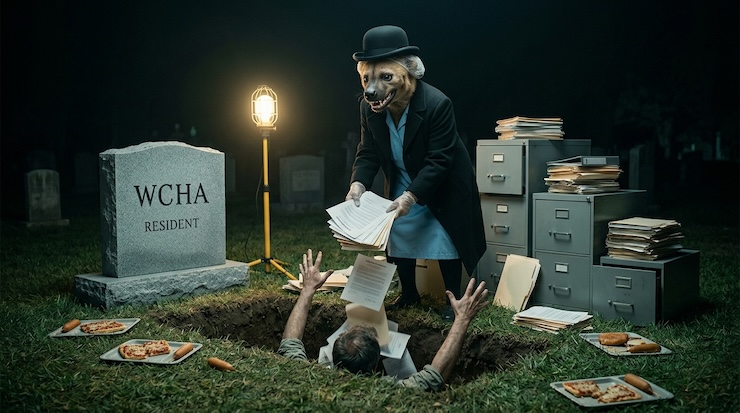
Illustration: Monster News
By Ronnie Paul Baker
FAIRFIELD, Ill. — For five consecutive months, ‘Resident N’ has lived under the shadow of a ticking administrative clock. Since April, the Wayne County Housing Authority has issued four separate notices terminating his lease at the Fairfield Hi-Rise, citing escalating debts and untested behavioral complaints. Each time, ‘Resident N’ did exactly what federal public housing regulations instruct a tenant to do: he filed a timely, formal demand for an administrative grievance hearing to dispute the charges.
And each time, the housing authority responded with silence — no hearing, no written disposition, and the eviction moving forward anyway.
Four notices, four filings, zero hearings. The procedural paper trail began on April 16, when WCHA Executive Director Kim Musgrave issued ‘Resident N’s first 30-day termination notice. It cited rent arrears and three behavioral allegations stretching back to January, including notes allegedly left on a neighbor’s door and unspecified “threatening and intimidating comments.” ‘Resident N’ filed a written grievance request three days later, disputing the allegations and asking to inspect the agency’s evidence.
The authority never scheduled a hearing. It never convened an informal settlement conference. It never issued a written disposition explaining why the grievance was denied.
Instead, on July 8, it issued a second 30-day notice. ‘Resident N’ answered with a second timely grievance request on July 26. The agency’s response arrived on July 27 in the form of a third termination notice — now appending a claim that ‘Resident N’ “continues” to make threatening remarks, with no dates, locations, or substance. His third grievance request followed on August 5, this one specifically challenging defects in how the papers were served. Again: no hearing, no hearing officer, no written response.
The fees nobody was told about. While the notices multiplied, the financial claims beneath them were quietly accumulating. ‘Resident N’s income-based rent is a modest income-based monthly rent plus a small utility charge. His ledger, signed by Musgrave, shows his last payment on March 10 brought the account current through April 1.
Then the ledger began carrying charges of its own. On April 7, May 6, June 8, and July 7, the authority assessed $20 penalties labeled “5th Day Late Fee.” On April 22 it added an unexplained $60 charge: “Legal Fees (Serve Papers)” — billed to the tenant for the cost of serving the authority’s own notices on him.
Under 24 C.F.R. § 966.4(b)(4), non-rent charges in public housing are not due and collectible until two weeks after the authority gives the tenant written notice of the charge — and that notice is itself an adverse action, entitling the tenant to grieve it before the money is even owed. The record shows no such notices for any of the five charges. The authority assessed them directly to the ledger and rolled them into the termination totals. By July, the balance had swollen past fourteen hundred dollars — including roughly $140 in fees that were never noticed, never due, and never subject to the grievance process the tenant kept trying to invoke.
The notices hollowed out. The first termination notice, whatever its defects, at least named things: specific amount allegations, a specific balance. Each successive notice carried less. By the fourth, the defective itemization was gone entirely. The August 24 notice cites a payment violation but states no amount owed, no months involved, no breakdown of charges, no accounting, no payment instructions, no cure amount, and no deadline by which payment would save the tenancy. It says only that the lease requires “Required Payments.”
Under both Illinois law (735 ILCS 5/9-209) and federal regulation (24 C.F.R. § 966.4), a landlord seeking termination for nonpayment must state the sum demanded and give the tenant a real opportunity to pay it. A tenant who receives “you owe Required Payments” cannot cure a default he cannot see. The burden of proving a lease violation sits with the housing authority; as ‘Resident N”s own grievance filings argue, this process handed it to him — asking him to disprove conclusions the authority never had to specify, before a hearing officer pre-loaded with an untested narrative of his character.
Read the rest of the story here.
